 Hipoteca Clara
Calculate your Spanish mortgage and what you save by repaying early
Two clear calculators for mortgages in Spain: the monthly payment with its amortization schedule, and the saving from repaying early by lowering the payment or shortening the term. Same logic as the Hipoteca Clara app.
Indicative results using the French amortization system, the usual one in Spain.
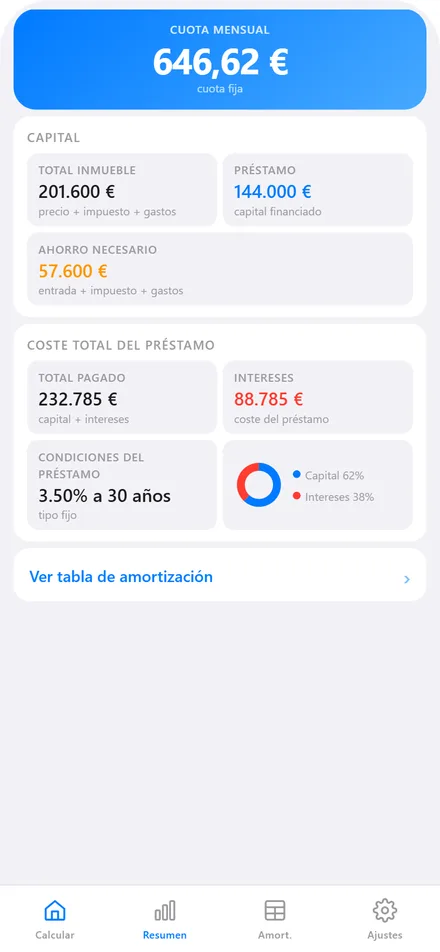
Two tools to understand your mortgage
No sign-up, no small print, and every calculation explained step by step.
Mortgage calculator
Monthly payment, total interest and an amortization schedule by month or by year. Fixed or variable rate (Euribor + spread) and the savings you need for the purchase.
Open calculatorEarly repayment calculator
Compare lowering the payment with shortening the term, deduct the fee and check the legal limit set by Spain's Law 5/2019.
Open calculatorWhy Hipoteca Clara
The same maths as the app
The web calculators use the same engine as the app and are checked against it on hundreds of cases, so the results match.
Built for Spain
IVA and ITP taxes, Euribor and the Spanish Law 5/2019 on real estate credit. Everything refers to the Spanish market.
No sign-up, no data
Calculations run in your browser. We ask for no account and send nothing you type to any server.
Explained, not just calculated
Every tool comes with its guide: how it is calculated, a worked example and the most common mistakes.
Also on your phone
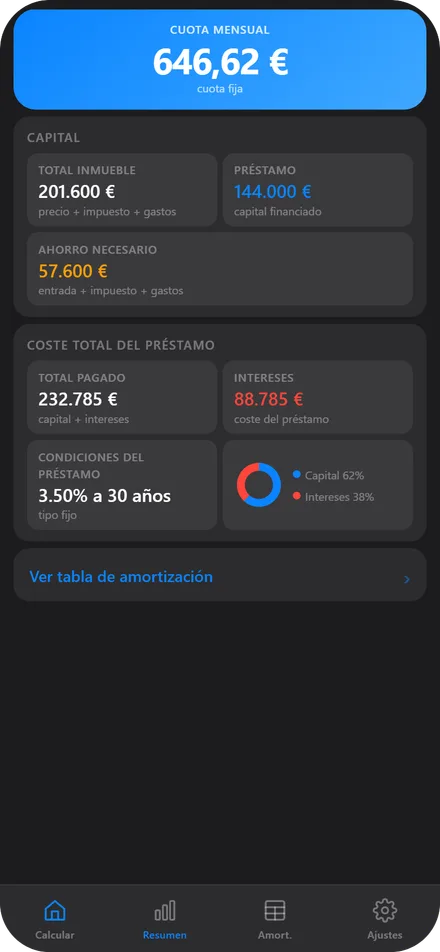
The Hipoteca Clara app does the same calculations offline, in 8 languages, with light and dark themes.
Guides to understand your mortgage
Clear explanations with worked examples about the most common questions.
How a mortgage payment is calculated in Spain
The constant-payment formula and a step-by-step example with capital and interest.
Read guide →Repaying a mortgage early in Spain: lower the payment or shorten the term?
Lowering the payment or shortening the term, how much each saves and the maximum legal fee.
Read guide →Fixed, variable or mixed mortgage in Spain
How each type of rate works and how much the payment can change on a variable one.
Read guide →What is Euribor and how it affects your mortgage
The index behind variable mortgages and how much the payment moves with each point.
Read guide →TIN, TAE and spread explained
What each one measures and why the TAE is higher than the rate when there are fees.
Read guide →Costs of buying a home in Spain: who pays what
Which taxes and costs come with buying and what the bank bears under Law 5/2019.
Read guide →Frequently asked questions
How is a mortgage payment calculated?
With the French amortization system: a constant payment that depends on the capital, the monthly interest rate and the number of instalments. At the start most of it is interest and, over time, the capital part grows. The payment guide explains it with an example.
What is the difference between TIN and TAE?
The TIN is the nominal interest rate used to calculate the payment. The TAE (annual percentage rate) also includes fees and other costs, so it is usually higher. The TAE is the figure used to compare offers. More in the guide on TIN, TAE and spread.
Is a fixed or a variable mortgage better?
There is no answer valid for everyone. A fixed rate gives a stable payment; a variable one moves with Euribor and can go up or down. It depends on how much risk you want to take and on your budget. We compare them in the guide on fixed, variable or mixed mortgages.
What is Euribor?
It is the reference interest rate most variable mortgages are tied to. The rate you pay is Euribor plus a spread. See the guide on what Euribor is.
Why is only the first payment exact on a variable mortgage?
Because the future value of Euribor is not known. The calculator uses the Euribor you enter for the first year and the "future Euribor" you assume from month 13. They are assumptions, not forecasts.